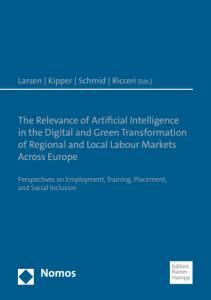
The Relevance of Artificial Intelligence in the Digital and Green Transformation of Regional and Local Labour Markets across Europe

The Secretary General of Eurispes Marco Ricceri, together with Christa Larsen, Managing Director of the Institute for Economics, Labour and Culture (IWAK), Jenny Kipper, lecturer at the Johann Wolfgang Goethe University and Alfons Schmid, former professor of Economics at the Johann Wolfgang Goethe University, took part in the publication entitled “The Relevance of Artificial Intelligence in the Digital and Green Transformation of Regional and Local Labour Markets Across Europe. Perspectives on Employment, Training, Placement and Social Inclusion”. The book was edited by Rainer Hampp, and its publication was promoted by Nomos, a leading academic publishing house in the fields of law, social sciences and humanities that publishes more than 850 books and over 50 journals annually.
The publication, which benefits from the contribution of the European Network on Regional Labour Market Monitoring, explores the role of Artificial Intelligence in optimising labour market dynamics within the digital and green transformation, with a focus on fair and sustainable employment. The text aims to analyse existing Artificial Intelligence solutions and, at the same time, highlights their potential role in supporting Public Employment Services in their activities in terms of monitoring and facilitating labour market actors at the regional and local levels.
After an extensive excursus on the fundamental elements of the debate around Artificial Intelligence and the state-of-the-art at a global level, the analysis focuses on the tools for assessing its impact on the labour market and finally on the emerging skills needs of which Artificial Intelligence is both a cause and a potential resource.
In the chapter “Artificial Intelligence: Ethical Codes and State Laws. An Open Process for a Competitive and Inclusive Society” Ricceri explores the legislative systems with respect to ethical codes in the field of Artificial Intelligence, starting with Canada and the US and then on to the EU strategy and, in particular, the proposal for a European Artificial Intelligence regulation.
Several initiatives at the global and European levels show a shared orientation towards the adoption of digital ethical codes.