
Eurispes, meeting with Uzbekistan think tank: developing new cooperation projects
A delegation consisting of representatives of Uzbekistan’s leading think tanks visited Rome. A series of meetings and dialogues were organised to present the reforms implemented in the Asian country and to further develop bilateral cooperation.
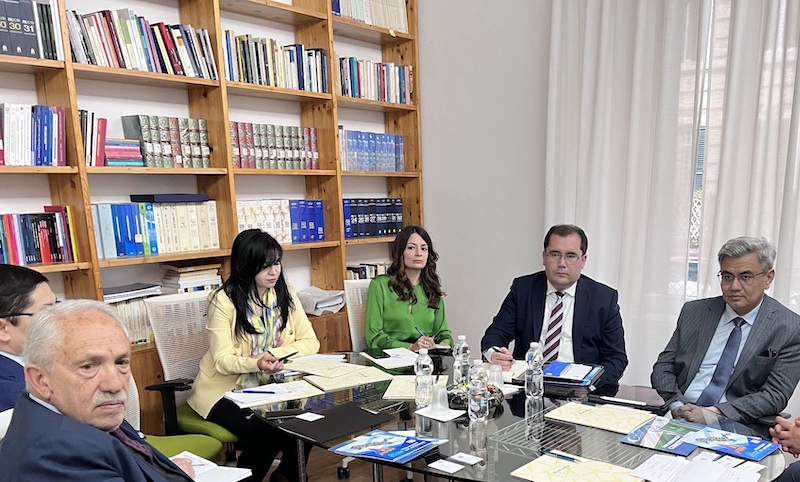
On April 13th, a delegation led by Eldor Tulyakov, Director of the Development Strategy Center, met at the Eurispes headquarters in Rome. The aim of the meeting was to illustrate the reforms implemented by the Uzbek government and open a dialogue to further develop bilateral cooperation.
The encounter allowed for an in-depth discussion on the respective initiatives, projects and working methods on the basis of the Collaboration Agreement (MOU) between the two Institutes, signed, on the Italian side, by the President of Eurispes, Gian Maria Fara, already in 2019.
During the course of the meeting, Director Tulyakov emphasised the changes that have taken place in Uzbekistan in recent years, in particular the contents of the New Uzbekistan Development Strategy for 2022-2026 and the monitoring of state programmes adopted within it, the main directions of the Centre’s activities in this context. For his part, Obid Khakimov, Director of the Centre for Economic Research and Reform, which operates under the administration of the President of the Republic of Uzbekistan, outlined the important initiatives being implemented to promote closer economic cooperation with Italy.
Established in 2017 on the basis of a decree of the President of the Republic of Uzbekistan, the “Center for Development Strategy” is strongly committed to promoting projects and actions in the five priority areas of development identified by the Uzbek government: modernisation of state structures, reform of the judiciary, strengthening of the market economy with a focus on the spread of small and medium-sized enterprises in the production system, social promotion, security, harmony between ethnic groups, and religious tolerance. A complex action that requires a systemic approach in assessing the problems to be addressed; an approach that conforms to Eurispes’ method of study and analysis.
There was great interest in the socio-economic reforms implemented in Uzbekistan. In particular, the efforts made by this country to strengthen and develop friendly relations with the world community, especially with neighbouring countries, based on cooperation, mutual support and peace, were highly appreciated.
The parties agreed to further develop cooperation between the think tanks of the two countries, with an ongoing analysis of the processes taking place in Uzbekistan in the social, economic, cultural and humanitarian spheres.
