Employment in Italy: a long-term analysis

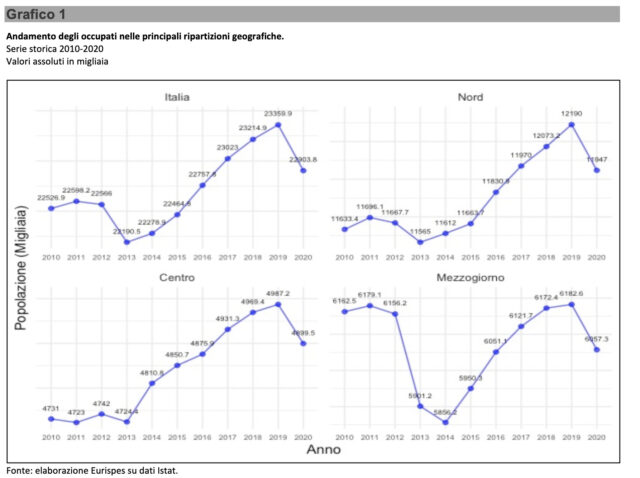
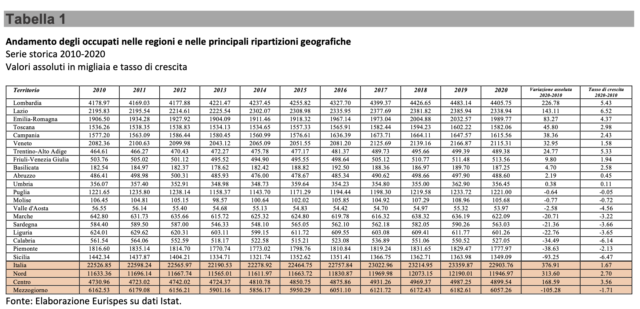
In Italy, 376.91 thousand new jobs were created between 2010 and 2020, an increase of 1.67%. An increase in employment that, however, was not homogeneous within the Country. The South, for example, saw a decrease of 105.28 thousand jobs (-1.71%). In the rest of the Country, the situation was better. The Centre increased the number of employed persons by 168.59 thousand and the North by 313.60 thousand. Therefore, if the North did better in absolute terms, the largest relative growth was recorded in the Centre, +3.56%, while that of the North was +2.7%.
Time trends in employment data
Looking more in detail at the temporal dynamics of employment, there has been a linear and constant growth throughout the Country since 2013, interrupted only in 2020 due to the emergency policies to deal with the Covid-19 pandemic. This growth also affected the South but was not captured by the growth rate seen above because the recovery failed to offset the sharp drop between 2013 and 2014, linked to the sovereign debt crisis, which hit the South harder than the rest of the Country. Since 2014, the South and the Islands have returned to growth, albeit at lower rates than the other geographical areas: the growth rate for this area between 2020 and 2013 was 2.65%; in the Centre, 3.71%; and in the North, 3.3%. Therefore, although the South is recovering, it cannot emerge from the crisis, as evidenced by lower growth rates and the failure to reach pre-crisis employment levels.
Employment at the territorial level
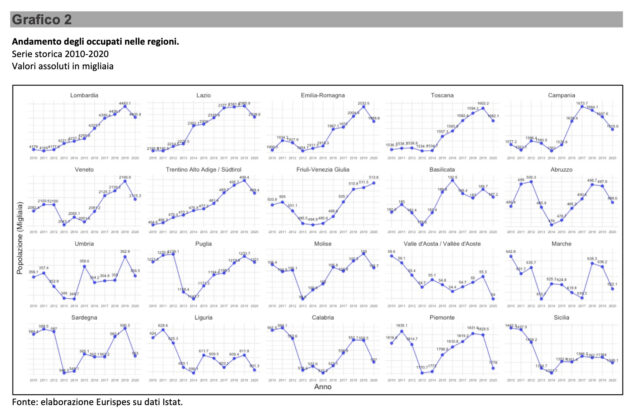
Examining employment trends in individual regions, a much more varied picture than the classic North-South dichotomy shows. Based on the characteristics of the employment trend over time, the regions can be categorised into five groups, which are heterogeneous concerning geographical location.
The first group is that of the most virtuous regions, which have had a constant and linear growth throughout the observation period. The group is made up of Lombardy, where jobs increased by 226.78 thousand (+5.43%); Lazio, with an increase of 143.11 thousand (+6.52%); Trentino-Alto Adige, which saw an increase of 24.77 thousand (+5.33%); and Emilia-Romagna, with a growth in jobs, compared to 2010 of 83.27 thousand (+4.37%).
In the second group, other regions have seen an increase in jobs, but which, unlike the former, only started to grow between 2013 and 2015. They are therefore expanding regions but less resilient than the first group. They include Tuscany, where the employed increased by 45.8 thousand (+2.98%); Veneto with an increase of 32.95 thousand jobs (+1.58%); and Friuli-Venezia Giulia, whose employed increased by 9.80 thousand (+1.94%). A peculiarity of the employment trend in Friuli-Venezia Giulia is that it is the only region that did not see a decrease in the year of the pandemic.
However, in the third group, some regions have demonstrated resilience without showing the capacity for growth. They are resilient in that they have managed to return to pre-crisis levels but have not seen a significant increase in jobs in recent years. Basilicata is in the third group, which had strong growth between 2013 and 2016, but unfortunately, this has come to a halt in recent years, with employment levels remaining stable. Basilicata’s increase compared to 2010 was 4.7 thousand jobs (+2.58%), while compared to 2013, it was 8.63 thousand (+4.83%). Campania is also in the third group, where employment increased strongly between 2015 and 2017. However, growth in recent years has reversed, and jobs have fallen again. Compared to 2010, there were 38.36 thousand new jobs in Campania (+2.43%). The third region is Umbria, whose employment trend had a modest growth compared to 2010, with an increase of 0.38 thousand (+0.11%), but more accentuated than 2013, with 7.47 thousand new jobs (+2.14%). Finally, the last region in the group is Abruzzo, which increased its jobs by 2.19 thousand units, recording a growth rate of +0.45%. Abruzzo, however, has a peculiarity in the trend of the number of employed persons that may invalidate the analysis. In the early years of the observation period, between 2010 and 2012, the employed in Abruzzo were growing, and only later, due to the sovereign debt crisis, did they decline. Therefore, if the region’s resilience is to be fully measured, the growth rate should be calculated with respect to 2012. In this scenario, the rate becomes negative (-0.02%) and indicates that the region has not been able to fully recover from the crisis. This would lead to Abruzzo being classified as belonging to the fourth group.
The fourth group brings together regions that have not been able to recover employment levels before the economic crisis. These are regions that have lost jobs rather than created them since 2010. These are Apulia, which lost 0.64 thousand jobs (- 0.05%); Molise, where the number of employed people decreased -0.77 thousand (-0.72%); Sardinia, with a decrease of 21.36 thousand jobs (-3.66%); Piedmont, -38.63 thousand jobs (-2.13%); Marche, -20.71 thousand employed (-3.22%); and finally Calabria, where employment fell by 34.49 thousand, recording one of the most alarming negative growth rates -6.14%. An essential role in limiting employment growth in these regions, except Puglia and Molise, was played by the Covid-19, which strongly reduced employment in 2020. These regions, however, showed stagnation in employment levels even before the pandemic, having failed to return to pre-crisis levels even in 2019.
Finally, in the last group, those regions did not show any resilience, whose employment level remained close to that of the sovereign debt crisis. Regions that have lost the most jobs over the last 10 years belong to this group. In this group are Liguria, which has lost 22.76 thousand jobs (-3.65%); Valle d’Aosta, with -2.58 thousand employed (-4.56%); and Sicily, which is the region where employment levels have fallen most significantly, both in absolute terms -93.25 thousand and in relative terms -6.47%.